
TLDR
Neurofunctional acupuncture is an anatomy-based needling approach used by trained physiotherapists and chiropractors to assess and influence how muscles, nerves and motor points communicate during movement. It differs from standard dry needling by incorporating systematic neuromotor assessment, optional electrical stimulation through the needles, and targeted movement retraining immediately after treatment. At Body Science Therapy in Mississauga, neurofunctional acupuncture is integrated into a comprehensive assessment process, including the Body Code system, to identify the root cause of persistent pain rather than treating symptoms in isolation.
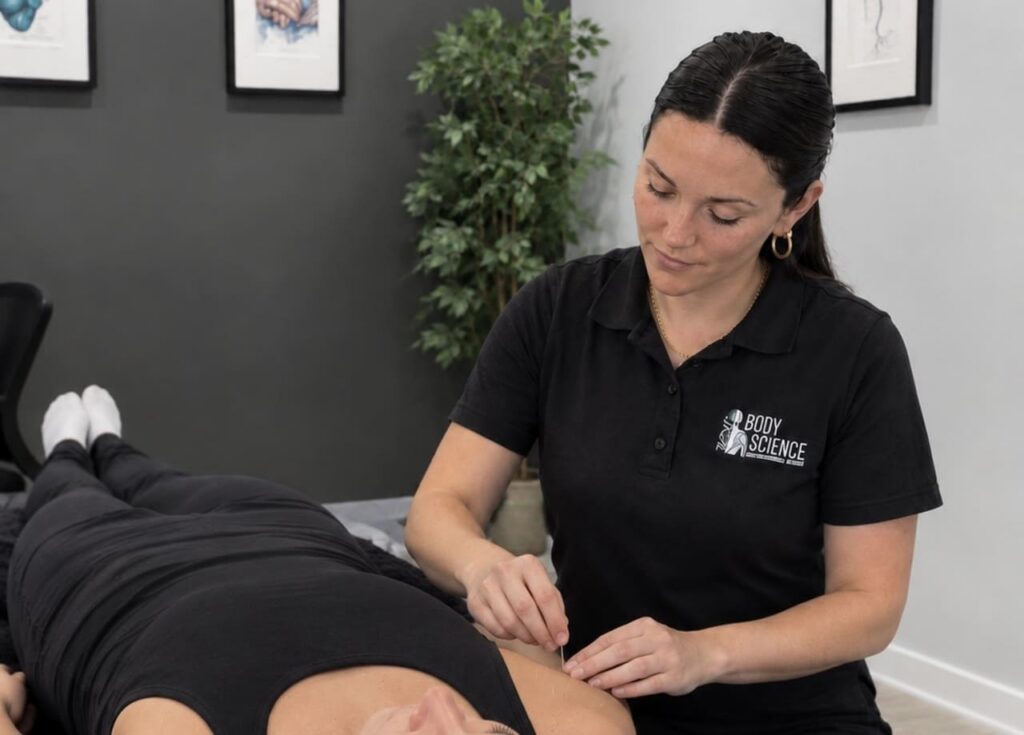
Persistent pain rarely lives in one place. Chronic back pain, recurring headaches, post-concussion neck tension and shoulder problems that keep coming back often share a common thread: the tissue that hurts is rarely the only tissue involved. Compensatory movement patterns, inhibited muscles and poorly coordinated activation sequences all contribute to why symptoms persist long after the initial injury or trigger has resolved.
Neurofunctional acupuncture addresses this clinical reality directly. Rather than placing needles where pain is reported, this approach uses neuroanatomy, motor point assessment and movement analysis to identify which muscles and nerves are contributing to dysfunction across the kinetic chain. It is used by both physiotherapists and chiropractors trained in this method, and it works best when embedded within a structured assessment and rehabilitation process.
This post explains what neurofunctional acupuncture is, how it compares to standard dry needling, what motor point assessment involves, and why movement retraining after needling is central to the clinical process.
What Is Neurofunctional Acupuncture?
Neurofunctional acupuncture is a modern, evidence-informed needling approach that uses fine acupuncture needles to influence muscles, peripheral nerves, motor points and movement control. It is grounded in Western neuroanatomy and physiology rather than traditional Chinese medicine meridian theory. Trained clinicians, including physiotherapists and chiropractors, use functional testing, palpation and movement analysis to guide where and how needles are placed.
The goal is not simply to reduce local pain. The treatment is designed to reduce neuromotor sensitivity, improve muscle activation quality and support better movement coordination. For patients managing neurofunctional acupuncture for chronic pain, this distinction matters. Many chronic pain presentations involve central sensitization, altered muscle recruitment and compensatory movement strategies that developed over months or years. Treating the symptomatic site without addressing those upstream patterns often produces short-term relief with limited carry-forward benefit.
At Body Science Therapy, neurofunctional acupuncture is not used as a standalone procedure. It is integrated into a personalized care plan built from a comprehensive assessment of movement, muscle activation, neuromotor function and health history.
How Does Neurofunctional Acupuncture Differ From Dry Needling?
Neurofunctional acupuncture and dry needling share similar tools but operate from different clinical frameworks. Understanding the distinction helps clarify what kind of clinical reasoning is guiding treatment.
Dry needling, as described in physiotherapy literature, typically focuses on myofascial trigger points: hypersensitive spots within a muscle that produce local or referred pain when compressed or stimulated. The aim is to release muscle tension, reduce trigger point sensitivity and decrease referred pain patterns. This approach is well-supported in the literature and is a legitimate component of musculoskeletal care. A literature review published on PubMed Central documents the clinical application and evidence base for dry needling across a range of musculoskeletal conditions.
Neurofunctional acupuncture and dry needling share the same type of needle, but the assessment process that guides needle placement is broader in the neurofunctional model. Rather than focusing solely on trigger points, the clinician assesses:
- How muscles are activating relative to one another during functional movement
- Whether a muscle is overactive, underactive or poorly timed in its recruitment sequence
- Where nerve-to-muscle communication breakdowns are occurring along the kinetic chain
- How the motor nervous system is responding to load, posture and movement demands
A tight muscle, in this framework, is not automatically a problem to release. It might be protective, compensatory, or working harder than it should because another muscle upstream or downstream is failing to activate properly. The assessment determines the reason before the needle is placed.
What Is Motor Point Assessment and Why Does It Matter?
Motor points are the locations on a muscle where the motor nerve enters and where electrical stimulation produces the strongest contraction response. Motor point assessment in acupuncture involves locating and evaluating these points to understand how well a muscle is responding to neural input.
Before needling, a trained clinician assesses the relevant movement system as a whole. This includes:
- Active and passive range of motion at relevant joints
- Muscle strength and the quality of activation patterns
- Pain referral patterns and symptom behaviour during movement
- Postural alignment and movement strategy under load
- Sensory changes or nerve-related symptoms in the region
- Functional tasks: squatting, lifting, reaching, rotating the neck
This process aligns closely with the Body Code assessment approach used at Body Science Therapy, which analyzes movement patterns and muscle activation sequences to identify where compensatory strategies have developed. The Body Code system recognizes that pain symptoms frequently originate from those compensatory patterns rather than from local tissue damage alone. Motor point assessment is one tool within that broader framework for identifying where neuromuscular dysfunction is contributing to the problem.
For conditions like chronic neck pain, shoulder dysfunction and persistent low back pain, this level of assessment changes the treatment targets considerably compared to a palpation-only or symptom-location approach.
What Role Does Electrical Stimulation Play?
Some neurofunctional acupuncture treatments include low-level electrical stimulation delivered through the inserted needles when clinically appropriate. This technique provides controlled neural input to the muscle and nerve at the treatment site, with the aim of influencing muscle tone, activation patterns and pain modulation through the nervous system.
Electrotherapy and movement retraining work together in this context. Electrical stimulation through needles is not the same as surface electrode-based electrotherapy. Because the input is delivered directly at the motor point, the effect on neuromuscular response is more targeted. Patients typically report sensations of mild pulsing, muscle twitching, heaviness, localized warmth or a dull ache, depending on the muscle being treated and the settings selected.
Stimulation intensity, needle placement, duration and frequency are selected by the treating clinician based on individual screening, contraindications and treatment goals. Patients with pacemakers, certain neurological conditions, active infections at the treatment site, or other relevant health factors require careful screening before electrical stimulation is considered.
Why Does Movement Retraining Follow Needling?
Neurofunctional acupuncture creates a window of neuromotor opportunity. After needling, muscle sensitivity is reduced, activation thresholds shift and the nervous system is more responsive to new input. Movement retraining during that window helps convert the treatment response into a functional change the nervous system retains.
Without structured movement retraining, symptom relief from needling alone is often short-lived. The movement patterns that loaded the symptomatic tissue in the first place remain intact, and symptoms tend to return as the nervous system reverts to its previous strategies. This is one of the reasons patients who have tried therapy before without sustained progress may benefit from an approach that explicitly links needling to graded movement rehabilitation.
Examples of post-needling movement retraining include:
- Neck control and endurance work following treatment for headaches or post-concussion neck tension
- Hip hinge mechanics and deep stabilizer activation after low back treatment
- Scapular control and rotator cuff coordination following shoulder or neck needling
- Gaze stability, balance and graded exertion progressions when symptoms relate to concussion recovery
This active component is not optional in the Body Science Therapy model. The objective is to restore the capacity to move, work, train and manage daily physical demands, not to provide passive relief during treatment hours alone. Weekend warriors returning to sport, people managing complex persistent pain and patients rebuilding capacity after a concussion all require this active, progressive element to move forward with confidence.
Which Conditions May Benefit From Neurofunctional Acupuncture?
Neurofunctional acupuncture is considered as part of a broader care plan for selected patients, based on assessment findings and individual health history. It is not a universal treatment, and clinical suitability varies. Common presentations where it may be incorporated include:
Condition | Potential Role of Neurofunctional Acupuncture |
Chronic neck and back pain | Address neuromuscular guarding, inhibited stabilizers and compensatory loading strategies |
Headaches and migraines with musculoskeletal contributors | Reduce cervical and suboccipital muscle sensitivity, support neck motor control |
Shoulder pain with altered activation | Improve scapular and rotator cuff muscle recruitment patterns |
Sports-related overuse injuries | Address load-related neuromuscular fatigue and coordination breakdown |
Post-concussion neck tension and movement sensitivity | Support cervical motor control when appropriately screened and medically cleared |
Hip and knee pain with altered movement patterns | Target underactive or overloaded muscles contributing to joint loading |
For neurofunctional acupuncture for headaches and migraines specifically, an expert consensus paper on dry needling practices for headache supports the use of needling techniques targeting cervical and suboccipital structures as part of a multimodal physiotherapy approach. Thorough screening is important, particularly when headaches are new, rapidly worsening or associated with neurological symptoms. This approach is not a substitute for appropriate medical evaluation when red flags are present.
Scar tissue is another underrecognized contributor to persistent pain and altered movement. At Body Science Therapy, scar management forms part of the clinical picture because scar tissue exerts neurological and mechanical effects throughout the surrounding tissue, contributing to ongoing pain and restricted movement well beyond the visible site of the scar.
For patients in Mississauga whose care involves both physiotherapy and chiropractic assessment, neurofunctional acupuncture integrates naturally into a multidisciplinary framework. Chiropractors trained in this method bring their assessment of joint mechanics, spinal function and neural input into the needling process, which complements the movement and muscle activation focus of physiotherapy. Both disciplines use motor point assessment and movement retraining within their scope; the shared framework allows for coordinated care when both are involved.
What Happens During a Neurofunctional Acupuncture Appointment?
A neurofunctional acupuncture session at Body Science Therapy follows a structured clinical process. Patients are not passive during this appointment. Assessment and movement testing occur before, during and after needling.
- Health history review and symptom discussion
- Screening for contraindications, precautions and relevant medical history
- Movement, strength and activation assessment guided by Body Code principles
- Identification of relevant muscles, motor points and nerve pathways
- Needle placement, with optional electrical stimulation when appropriate
- Post-needling reassessment of movement, strength or symptoms
- Movement retraining, exercise prescription or patient education based on findings
Short-term responses after treatment often include temporary local soreness, heaviness in the treated area, mild fatigue or localized tenderness for 24 to 48 hours. These responses are generally normal and are reviewed during the appointment. Treatment plans are adjusted based on individual response rather than following a fixed protocol. Patients are encouraged to ask questions about the clinician’s training, the consent process, expected sensations and how needling fits within the full care plan.
Key Takeaways
- Neurofunctional acupuncture is a neuroanatomy-based needling approach used by trained physiotherapists and chiropractors to assess and influence how muscles, motor points and nerves contribute to pain and movement dysfunction.
- It differs from standard dry needling by incorporating systematic neuromotor assessment, evaluating muscle activation sequences and movement patterns across the kinetic chain rather than focusing solely on trigger point release.
- Motor point assessment identifies where nerve-to-muscle communication is disrupted, guiding more precise treatment targeting for chronic pain, headaches, shoulder dysfunction and post-concussion presentations.
- Optional electrical stimulation through the needles provides controlled input to muscles and nerves, with effects on pain modulation and activation patterns; intensity and placement are selected after individual screening.
- Movement retraining immediately following needling is clinically necessary to translate symptom changes into durable functional improvements.
- At Body Science Therapy, neurofunctional acupuncture is integrated with the Body Code assessment system, Neurokinetic Therapy (NKT), Dolphin Neurostim MPS and progressive movement rehabilitation to address root cause rather than symptomatic presentation.
Ready to Find the Source of Your Pain and Build a Plan That Moves Forward?
Neurofunctional acupuncture is most clinically useful when it is part of a clear process: assess the neuromuscular system, treat the relevant structures and retrain the movement patterns that keep symptoms returning. For patients in Mississauga managing chronic pain, recurring headaches, migraines, post-concussion neck tension or back pain that has not responded to previous therapy, a thorough assessment is the starting point.
Body Science Therapy uses the Body Code assessment, Neurokinetic Therapy (NKT), Dolphin Neurostim MPS and neurofunctional acupuncture as part of a personalized, root-cause approach to musculoskeletal and neuromotor conditions. Learn more about our Chiropractic Care and neurofunctional acupuncture services in Mississauga, or schedule a consultation to understand what is driving your symptoms and which treatment options fit your condition, goals and health history.
Frequently Asked Questions
Is neurofunctional acupuncture the same as dry needling?
They are related but not identical. Both use fine needles, but dry needling typically focuses on myofascial trigger points and local muscle dysfunction, while neurofunctional acupuncture uses a broader assessment of muscles, nerves, motor points and movement patterns to guide treatment. The clinical reasoning process differs even when the tools look similar. The specific approach used depends on the clinician’s training and the patient’s presentation.
Can neurofunctional acupuncture help with chronic pain?
It is considered for some chronic pain presentations, particularly when muscle guarding, altered activation patterns, nerve sensitivity or compensatory movement strategies are contributing to ongoing symptoms. Chronic pain conditions rarely involve a single tissue or site, and neurofunctional acupuncture addresses this by targeting the neuromuscular system rather than the symptomatic location alone. It is most effective when integrated into a broader plan that includes comprehensive assessment, movement retraining and patient education.
Is neurofunctional acupuncture safe?
When performed by a trained, regulated professional following proper screening and informed consent, needling techniques are considered low risk for appropriate patients. Possible short-term side effects include local soreness, bruising, fatigue or lightheadedness. Patients with pacemakers, active infections, certain bleeding disorders, relevant medications or pregnancy-related considerations should discuss these factors before treatment begins to determine whether needling is appropriate for their situation.