TLDR
Neurofunctional acupuncture targets nerves, muscles, and sensorimotor pathways to reduce protective guarding and improve movement readiness, but it does not rebuild strength, coordination, or movement control on its own. When paired with targeted movement rehabilitation, the temporary nervous system changes created by needling become the foundation for more durable functional improvement. Without the exercise component, many people notice that pain settles briefly before returning with the same triggers.
Most people arrive at a clinic hoping for pain relief. What they often do not expect to hear is that the treatment doing the most work might not be the needles at all. It might be what happens after.
Neurofunctional acupuncture has earned a growing place in evidence-informed practice, and for good reason. It works on the nervous system at a level that other manual approaches cannot always reach. But here is the clinical reality that does not get discussed enough: needling creates a window of opportunity. What you do with that window determines how meaningful and durable the change becomes.
This post covers how neurofunctional acupuncture works, why movement rehabilitation is the necessary second half of that equation, what an integrated assessment-driven plan looks like in practice, and how this approach applies to chronic pain, headaches, migraines, concussion recovery, and recurring sports-related flare-ups.
Is Neurofunctional Acupuncture the Whole Treatment or Just the Starting Point?
Neurofunctional acupuncture is a clinically applied needling approach that targets peripheral nerves, muscle tissue, and sensorimotor pathways with the goal of influencing pain signalling, muscle tone, and movement control. It is distinct from traditional Chinese acupuncture in that its application is guided by neuroanatomy and clinical reasoning rather than meridian theory.
When applied appropriately, needling influences both peripheral and central nervous system activity, which is why it can produce rapid changes in how a muscle responds, how much protective guarding is present, or how freely a joint moves. These are real, clinically observable changes. They are also temporary in isolation.
Think of it this way. Needling reduces the nervous system’s current level of defensive output. It does not teach the nervous system a better pattern. It does not load a muscle back to the strength it needs. It does not retrain coordination or restore confidence in movement. That is the work of structured rehabilitation, and without it, the nervous system tends to drift back to the same compensations it was using before.
Both physiotherapists and chiropractors use neurofunctional acupuncture within their clinical practice, and both disciplines bring specific value to the rehabilitation side of this equation. Physiotherapists contribute movement analysis, graded loading, and progressive exercise prescription. Chiropractors bring expertise in neuromuscular function, spinal mechanics, and sensorimotor integration. When these disciplines work within an integrated plan, the assessment and the active treatment that follows it become considerably more precise.
Why Does Pain Keep Coming Back Without Movement Retraining?
Chronic pain is not always a tissue-damage problem. In many persistent cases, the nervous system itself has become sensitized, meaning it generates pain signals in response to inputs that would not normally be threatening. Central sensitization and nociplastic pain describe conditions where the pain experience is amplified beyond what local tissue findings would predict. Altered muscle recruitment, avoidance of certain movements, and compensation patterns layer on top of this over time.
Passive treatment, including needling, often provides genuine short-term relief in these situations. The problem is that the underlying movement pattern does not change. Muscles that have learned to underperform continue to underperform. Adjacent structures that have been compensating continue to compensate. The same activity, posture, or load that provoked the symptoms before will provoke them again.
This pattern shows up consistently in chronic back pain, persistent headaches and migraines where cervical and shoulder mechanics are a contributing factor, post-concussion intolerance to movement and exertion, and recurring sports-related flare-ups in weekend warriors who return to activity without addressing the neuromuscular dysfunction underneath the symptoms.
Relief and recovery are not the same thing. Relief is a reduction in current symptoms. Recovery is a change in the system that was generating those symptoms.
How Does the Exercise Component Turn a Temporary Reset Into a New Pattern?
Research comparing acupuncture combined with rehabilitation exercise to acupuncture alone consistently shows that the combination produces stronger functional outcomes. The sequence matters: assess, apply needling where clinically indicated, then reinforce improved movement while the nervous system is more receptive to new input.
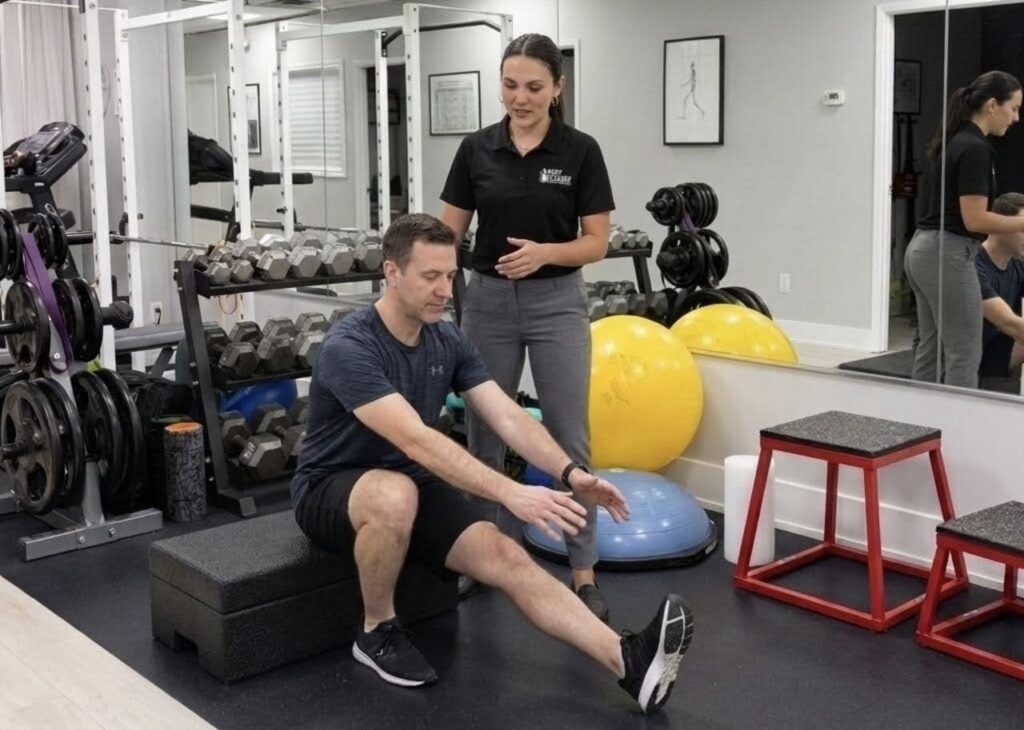
The exercise component is not generic. It is not a sheet of standard stretches or a referral to the gym. Targeted rehabilitation following neurofunctional acupuncture addresses specific movement problems identified through assessment. Depending on what the assessment reveals, this work draws from several categories:
- Mobility work to restore comfortable range of motion in areas where protective guarding was limiting access
- Motor control drills to improve timing, sequencing, and coordination between muscle groups that have drifted into compensation patterns
- Strength progressions that build load tolerance in structures that have been underloaded or avoided
- Balance and vestibular drills when concussion recovery or sensorimotor instability is part of the picture
- Graded aerobic progression when fatigue sensitivity and exertion intolerance are present
The goal is precise neuromuscular input that matches the specific dysfunction found during assessment, not activity for its own sake.
What Does This Approach Look Like for Different Conditions?
Chronic Back Pain
Neurofunctional acupuncture for chronic pain is most useful when nervous system overprotection, altered muscle recruitment, or movement avoidance are contributing to the persistence of symptoms. Needling addresses the neurological component; structured movement work then reloads the system progressively, building the tolerance that makes daily activity and return to function genuinely accessible.
Headaches and Migraines
When headaches and migraines involve cervical mechanics, jaw tension, shoulder girdle dysfunction, or breathing pattern irregularities, these areas become relevant targets within a broader assessment. Needling addresses local neuromuscular contributions; rehabilitation addresses the mechanical and postural patterns that keep those tissues in a state of irritability. No claim is made here that acupuncture resolves migraines; what an assessment-driven plan addresses is the neuromuscular environment that contributes to symptom frequency and severity for some individuals.
Concussion Recovery
Post-concussion symptoms often involve cervical dysfunction, vestibular disruption, visual tracking difficulties, and exertion sensitivity. Neurofunctional acupuncture for concussion recovery serves as one supportive tool within a broader plan that addresses each of these systems. Cervical rehabilitation, vestibular retraining, visual-motor exercises, and carefully paced aerobic progression form the active work that creates lasting functional change. Symptom-guided progression is essential; this is not a condition where more is always better.
Weekend Warriors and Active Adults
For people returning to sport, recreational activity, or physically demanding work after injury or a flare-up, the goal is not simply reducing pain. The goal is restoring the movement quality, strength, and load tolerance that specific activities demand. Short-term symptom relief without that functional progression tends to end with re-injury or the same flare-up cycle repeating.
What Are the Signs a Standalone Approach Is Missing Part of the Picture?
Recognizing these patterns is not about assigning fault to any previous treatment. It is about identifying where the strategy needs to evolve.
- Pain settles for a few days after treatment but returns reliably with the same movement, load, or activity
- Symptoms improve during or immediately after a session but do not translate into better capacity for lifting, walking, running, training, working, or sleeping
- There is no reassessment of how movement, strength, or activity tolerance is changing over time
- Sessions do not include clear direction for what to practice or progress between visits
- The treatment plan does not change as symptoms change
If any of these sound familiar, it does not mean previous treatment failed. It means the strategy needs a bridge between nervous system input and movement retraining.
How Should a Root-Cause Oriented Plan Be Built?
At Body Science Therapy, assessment comes first. The Body Code assessment is a systematic evaluation of movement patterns, muscle activation sequences, and compensatory neuromuscular behaviour across the kinetic chain. This approach recognizes that pain symptoms frequently originate from dysfunction upstream or downstream of where the symptom is felt, not just at the local tissue level.
This assessment informs whether neurofunctional acupuncture is clinically appropriate and, if so, exactly where and how it fits within the broader plan. Tools like Neurokinetic Therapy (NKT), a manual technique that identifies which muscles are inhibited and which are compensating, and Dolphin Neurostim MPS, a microcurrent point stimulation approach that addresses neuromuscular and fascial tension, are integrated where they serve the clinical reasoning behind the plan. Scar tissue assessment is also part of this picture, as scar tissue carries real neurological implications that contribute to pain and restricted movement in ways that are often overlooked.
The plan progresses from symptom modulation through capacity-building: less guarding, restored range, improved neuromuscular control, increased tolerance to activity, and return to meaningful function. Patients are equipped with the knowledge and movement tools to contribute to their own progress between sessions, because lasting functional change is built in part through consistent, informed daily input.
A safety note: individuals with medical complexity, blood thinner use, pregnancy, active infection, or neurological red flags require careful screening before needling is considered. A thorough intake and clinical assessment are non-negotiable starting points.
For more information about how chiropractic care integrates into this kind of assessment-driven approach, visit the neurofunctional acupuncture service page for a closer look at the clinical application.
Key Takeaways
- Neurofunctional acupuncture targets nerves, muscles, and sensorimotor pathways to reduce protective guarding and improve movement readiness, but it does not rebuild strength, coordination, or movement control independently.
- Both physiotherapists and chiropractors use neurofunctional acupuncture within their practice, and both disciplines contribute meaningfully to the rehabilitation component of an integrated plan.
- Research supports combining acupuncture with rehabilitation exercise over acupuncture alone for functional outcomes, particularly in chronic and complex presentations.
- Chronic pain, persistent headaches, migraines, post-concussion symptoms, and recurring sports injuries frequently involve sensitized nervous system pathways and altered muscle recruitment patterns that require active retraining, not passive treatment alone.
- The Body Code assessment evaluates the full kinetic chain to identify neuromuscular dysfunction and compensation patterns, informing a plan that targets the contributing factors rather than the symptom location alone.
- Patients who understand the reasoning behind their plan and are equipped with movement tools to use between sessions are better positioned to build functional capacity over time.
Ready to Understand Why Your Symptoms Keep Returning?
If pain has settled and returned in the same pattern more than once, or if previous treatment provided short-term relief without lasting functional change, a detailed assessment is the starting point worth investing in. At Body Science Therapy in Mississauga, the approach begins with understanding the neuromuscular and movement factors driving your symptoms, then building a plan that connects nervous system treatment with the active rehabilitation needed to restore your capacity for the activities that matter to you.
Book an assessment to find out what your movement patterns, muscle activation, and symptom history reveal about the root cause of your pain, and what a structured plan forward looks like for your specific situation.
Frequently Asked Questions
Is neurofunctional acupuncture enough on its own?
For most people, it is not sufficient as a standalone treatment. Neurofunctional acupuncture addresses nervous system contributors to pain and movement restriction, but it does not rebuild the strength, coordination, or movement patterns that keep symptoms from recurring. When paired with specific exercise that matches what the assessment finds, many people notice that the changes created by needling become more durable and functionally meaningful.
Can neurofunctional acupuncture help with chronic pain?
It is appropriate for some people with chronic pain, particularly when central sensitization, muscle guarding, or altered movement control are contributing factors. Whether it is clinically indicated depends on a thorough assessment of pain behaviour, neurological signs, movement capacity, and previous treatment response. It is one tool within a broader plan, not a standalone solution for all chronic pain presentations.
Should exercise happen right after an acupuncture session?
In many cases, yes. When needling produces a temporary change in muscle activation or movement readiness, guided movement immediately following the session gives the nervous system the opportunity to practise a better pattern during that window of receptivity. The timing, type, and intensity of that movement should be individualized based on the current state of the nervous system, symptom irritability, and the specific goals of the session.