
TLDR
Neurofunctional acupuncture works by delivering needle-induced sensory input to influence how the nervous system processes movement, muscle activation, and pain signals. It is a clinical tool used within a broader rehabilitation plan, not a standalone treatment. Lasting functional change typically requires pairing acupuncture with targeted assessment, movement retraining, and progressive exercise.
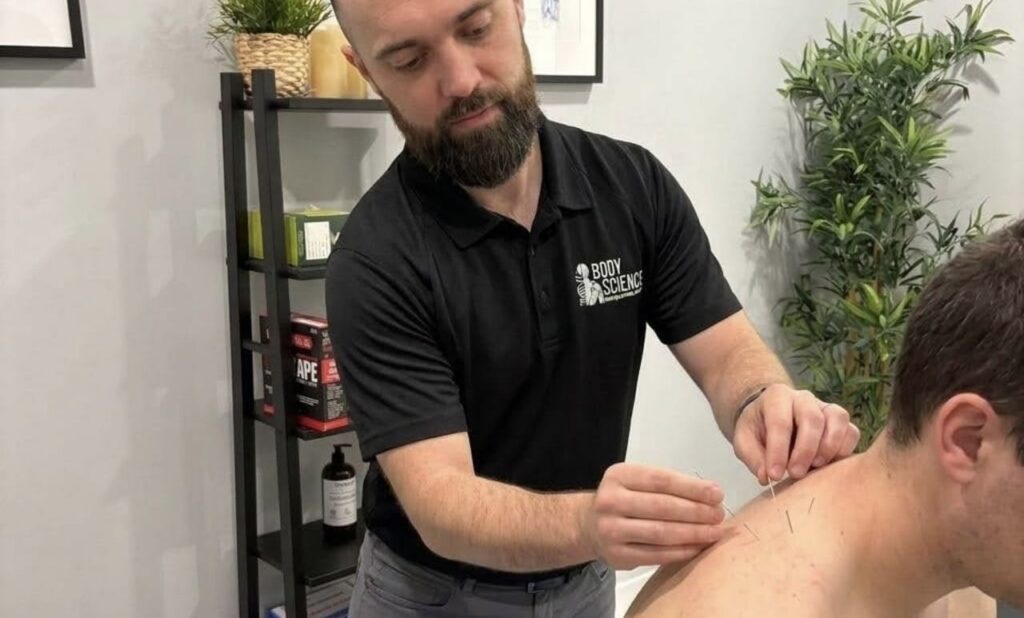
If you have lived with chronic pain, recurring headaches, or persistent back tension and tried therapy with little to show for it, the idea of acupuncture as a solution probably raises some reasonable skepticism. And that skepticism is worth taking seriously.
Neurofunctional acupuncture is not a passive treatment where needles go in and pain disappears. It is a neurologically grounded clinical tool designed to influence how your nervous system interprets sensory input, coordinates muscle activity, and responds to movement. When it is applied accurately, within a rehabilitation plan that includes active assessment and progressive exercise, many people notice meaningful improvements in how their body moves and feels.
This post explains what neurofunctional acupuncture actually does in the nervous system, why chronic pain is often a sensitivity problem rather than a tissue damage problem, and why what you do after treatment is just as important as the treatment itself.
Myth Busted: Is Neurofunctional Acupuncture Just Passive Pain Relief?
No. Feeling less pain after a session is not the same as functional recovery. Pain reduction is a signal worth paying attention to, but it does not automatically mean the underlying movement problem has been addressed.
Here is the distinction that matters. Pain decreases when the nervous system receives more accurate, organized sensory input. Needling specific motor points or nerve pathways introduces a precise mechanical stimulus that the nervous system registers and responds to. That response can include reduced muscle guarding, improved activation of underactive muscles, and a temporary shift in how the brain processes threat signals from a particular region. That is genuinely useful. But it does not rebuild strength, restore coordination, or retrain movement patterns on its own.
Neurofunctional acupuncture works within a broader rehabilitation plan. Physiotherapists and chiropractors who are trained in neurofunctional acupuncture use it as one component of a clinical strategy, not as a substitute for assessment-driven exercise and movement retraining. At Body Science Therapy, this approach is grounded in identifying root causes before selecting treatment methods, using assessments like the Body Code, which is a systematic evaluation of neuromuscular function that analyzes movement patterns and muscle activation sequences across the entire kinetic chain rather than focusing on isolated symptoms.
Outcomes vary based on condition complexity, how long symptoms have been present, individual nervous system sensitivity, and consistency of follow-through. Setting realistic expectations from the start is part of responsible clinical care.
How Does Neurofunctional Acupuncture Work in the Nervous System?
Neurofunctional acupuncture works by using needle-induced sensory stimulation to influence how the nervous system regulates muscle activity and processes pain. To understand why that matters, it helps to understand proprioception.
What Is Proprioception and Why Does It Matter?
Proprioception refers to the body’s internal system for sensing joint position, muscle tension, and movement in space. Specialized receptors in muscles, tendons, and joints send continuous signals to the spinal cord and brain, allowing the nervous system to coordinate movement without conscious thought. When proprioceptive input is disrupted, by injury, overuse, guarding, or chronic pain, muscle coordination suffers, movement patterns compensate, and pain sensitivity often increases.
Needle stimulation at motor points and along specific nerve pathways introduces a precise proprioceptive input that the nervous system registers and responds to. Research on dry needling and acupuncture mechanisms, including work published on dry needling peripheral and central considerations, describes how needling activates sensory receptors that communicate with the spinal cord and brain, influencing both local muscle activity and central pain processing.
What Does This Mean for Motor Control?
Neurofunctional acupuncture and motor control are closely connected. The goal is often to help muscles that have become inhibited, guarded, or poorly coordinated participate more effectively in movement. This is relevant for chronic back pain where hip-spine coordination breaks down, for post-concussion neck tension where deep cervical muscles lose their activation timing, and for recurring headaches where jaw and upper cervical muscle tone is dysregulated.
Additional research on acupuncture mechanisms and peripheral nervous system function supports the idea that needling influences sensory nerve pathways in ways that extend beyond the local tissue, affecting how signals are processed further up the nervous system. This is why neurofunctional acupuncture practitioners assess movement, strength, activation patterns, and sensitivity before selecting treatment points, rather than applying a standard protocol.
Why Is Chronic Pain Not Always a Tissue Damage Problem?
Chronic pain is often a nervous system sensitivity problem rather than a structural one. Central sensitization refers to a state where the nervous system becomes heightened in its response to input, amplifying pain signals beyond what the actual tissue condition warrants.
Signs of central sensitization include pain that spreads beyond the original injury site, symptoms that flare easily with minimal activity, sensitivity to pressure or temperature, inconsistent pain patterns, and pain that seems disproportionate to what you are doing. These presentations are common in people with chronic back pain, migraines, headaches, post-concussion symptoms, and long-standing musculoskeletal conditions.
This does not mean pain is imagined or exaggerated. It means the nervous system has adopted a protective pattern that outlasts its usefulness, and that pattern requires targeted retraining, not just rest or symptom management. As Physiopedia’s overview of neurology treatment techniques outlines, interventions aimed at influencing the nervous system directly are a recognized part of rehabilitation for conditions where central processing plays a significant role.
Neurofunctional acupuncture for chronic pain addresses this by introducing organized sensory input that helps the nervous system recalibrate its threat response. Combined with tools like Neurokinetic Therapy (NKT), which identifies faulty movement compensation patterns, and Dolphin Neurostim MPS, which uses microcurrent stimulation to address scar tissue and neurofascial tension, the approach targets the neuromuscular contributors to pain rather than the symptoms alone.
Why Is Exercise After Acupuncture Where Functional Change Is Built?
Acupuncture creates a window. What you do inside that window determines whether the improvement holds.
After a session, many people notice reduced muscle guarding, improved range of motion, or clearer movement in areas that previously felt restricted. The nervous system is temporarily more receptive to new input. That receptivity is a clinical opportunity. Movement performed in this state helps the brain reinforce the new activation pattern, making it more likely to carry forward.
Neurofunctional acupuncture exercise rehab is not optional follow-up. It is the mechanism through which the nervous system consolidates the changes introduced during treatment. This is why physiotherapists and chiropractors trained in neurofunctional acupuncture integrate specific movement tasks immediately after needling, rather than sending patients home to rest.
The exercises themselves are determined by clinical findings, not by a standard protocol. Depending on the condition, follow-up work might involve controlled mobility drills, breathing and pressure regulation strategies, balance and proprioceptive training, graded strength activation, cervical stability work, or progressive return-to-activity movements. The patient’s active participation is not a bonus. It is a requirement for the system to retrain effectively.
Which Conditions Might Benefit From This Approach?
Condition | Relevant Contributing Factors | How Neurofunctional Acupuncture Fits |
Migraines and headaches | Neck mobility restrictions, upper cervical muscle tone, jaw tension, stress loading, concussion history | Targets motor point dysregulation in cervical and masticatory muscles, reduces sensitization contributing to headache frequency |
Chronic back pain | Persistent guarding, poor hip-spine coordination, altered lumbar muscle recruitment, compensation patterns | Improves muscle activation sequencing across the kinetic chain, supports retraining of coordination patterns |
Post-concussion symptoms | Deep cervical inhibition, cervicogenic headache, visual-vestibular dysregulation, sensitivity amplification | Addresses local cervical neuromuscular dysfunction as part of a graduated return to activity |
Complex pain presentations | Sensitivity amplification, movement avoidance, previous injuries, scar tissue, repeated flare-ups | Used alongside NKT and Dolphin Neurostim MPS to address neuromuscular compensation and scar-related neurological interference |
A thorough assessment is required before proceeding with neurofunctional acupuncture for any condition. For some presentations, other care takes priority, or a referral is appropriate. Neurofunctional acupuncture should be performed by a trained regulated healthcare professional using clean needle technique, individualized clinical reasoning, and a clear understanding of contraindications. Both physiotherapists and chiropractors with specific post-graduate training in neurofunctional acupuncture apply this approach within their respective scopes of practice, each bringing their clinical training to the assessment and treatment process.
What Happens During a Neurofunctional Acupuncture Appointment?
The appointment begins with assessment, not with needles. Placing needles without a clear clinical picture is not how this approach is designed to work.
A thorough appointment typically includes movement testing to identify restrictions or compensations, strength and muscle activation testing, neurological screening where relevant, palpation of soft tissues and motor points, a review of symptom behavior and history, and goal setting based on functional priorities. At Body Science Therapy, this process is guided by the Body Code assessment, which examines the full kinetic chain to identify where upstream mechanical failures or neuromuscular compensation patterns are contributing to the presenting problem.
Needle placement is determined by those findings. Needles are positioned at motor points, along specific nerve pathways, or in regions contributing to the movement dysfunction. The sensation varies. Some people notice a muscle twitch response, warmth, heaviness, or temporary local soreness. Others notice very little. Neither response predicts the outcome on its own.
Improvement is immediate for some people and gradual for others. For conditions involving chronic pain, migraines, headaches, or post-concussion presentations, progress tends to follow a pattern of reassessment, adjustment, and progressive exercise integration over several visits rather than a single session. The clinical goal is to give patients both the treatment and the tools to contribute to their own recovery, building understanding of how their body works so that recovery becomes increasingly self-directed over time.
Key Takeaways
- Neurofunctional acupuncture is a neurologically grounded clinical tool that influences muscle activation, proprioceptive input, and pain processing. It is not a standalone treatment and does not produce reliable functional change without assessment-driven rehabilitation.
- Needle stimulation introduces sensory input that the nervous system interprets and responds to, potentially improving motor control, reducing protective muscle guarding, and shifting central pain sensitivity.
- Central sensitization is a recognized contributor to chronic pain, migraines, headaches, and post-concussion symptoms. Neurofunctional acupuncture addresses sensory system dysregulation as part of a broader rehabilitation strategy.
- Exercise and movement retraining performed after needling are critical for consolidating nervous system changes. The post-treatment window is an opportunity to reinforce improved activation patterns.
- Both physiotherapists and chiropractors with post-graduate training in neurofunctional acupuncture apply this approach within their scopes of practice, using clinical assessment to guide needle selection and rehabilitation planning.
- Tools such as Neurokinetic Therapy (NKT), Dolphin Neurostim MPS, and the Body Code assessment support a root-cause approach by identifying neuromuscular compensation patterns that contribute to pain rather than addressing symptoms alone.
Decrease Pain. Improve Motion. Retrain the System.
Persistent pain, recurring headaches, chronic back pain, concussion-related symptoms, or movement limitations that have not responded to previous care are not dead ends. They are signals that the underlying neuromuscular contributors have not yet been identified or addressed.
At Body Science Therapy in Mississauga, our physiotherapists and chiropractors use the Body Code assessment alongside neurofunctional acupuncture, Neurokinetic Therapy (NKT), and Dolphin Neurostim MPS to build individualized rehabilitation plans grounded in clinical findings rather than symptom management alone. The goal is to give you a clearer picture of what is driving your symptoms, a targeted plan to address it, and the knowledge to contribute actively to your own recovery.
Book an assessment to identify the root drivers of your symptoms and determine whether neurofunctional acupuncture belongs in a personalized plan built around your function, your goals, and your capacity to heal.
Frequently Asked Questions
Is neurofunctional acupuncture the same as traditional acupuncture?
No. Neurofunctional acupuncture is applied within a modern neuromuscular and nervous system framework, with needle placement guided by clinical assessment findings such as motor control deficits, nerve sensitivity, muscle activation patterns, and movement limitations. Traditional acupuncture is based on a different theoretical system. While some techniques overlap, the clinical reasoning and selection criteria differ significantly.
How many sessions of neurofunctional acupuncture will I need?
The number of sessions depends on the condition, how long it has been present, and how the nervous system responds to treatment. Chronic pain, migraines, headaches, concussion-related symptoms, and long-standing movement issues typically require reassessment over several visits and a combination of acupuncture, exercise rehabilitation, and progressive activity. A clinical assessment gives a clearer sense of what a realistic course of care looks like for your specific situation.
Can neurofunctional acupuncture help if other therapy has not worked?
It is worth exploring if previous care focused primarily on symptom relief without addressing motor control, central sensitization, or movement retraining. Conditions involving neuromuscular compensation, scar tissue interference, or sensitivity amplification often respond differently when the root cause is identified first. A clinical assessment is the appropriate starting point to determine whether this approach fits your condition and goals.