
TLDR
A child who performs a movement once during a tryout or backyard drill is not necessarily ready for the full physical demands of a sports season. True sports readiness includes conditioning, proprioception, strength, and the ability to repeat movements accurately under fatigue. A physiotherapy assessment before the season starts helps identify gaps in movement quality, load tolerance, and neuromuscular control so parents have a clearer picture of where their child stands.
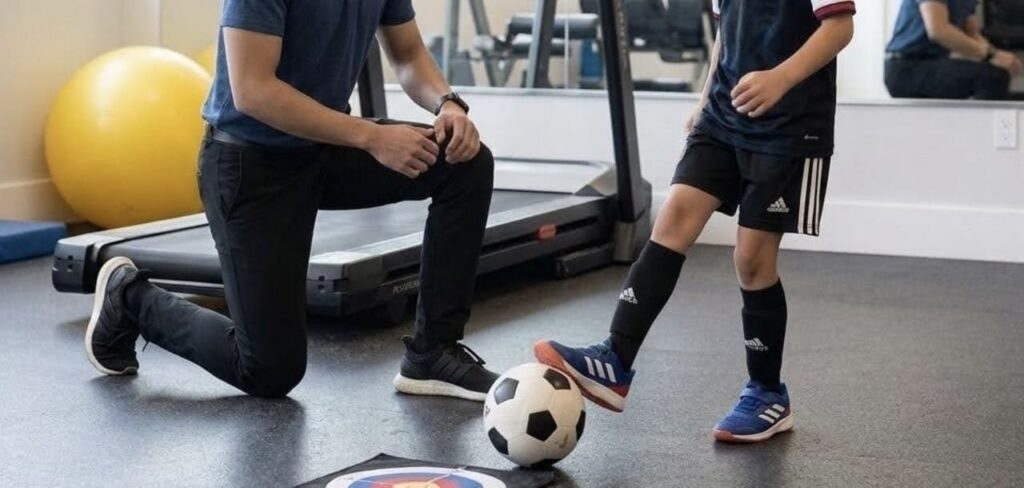
Watch a child sprint down the field, land a jump cleanly, or fire off a throw with good form, and it is easy to feel reassured. They can do the move. They look ready. But a single clean repetition during a tryout or practice is not the same as being physically prepared to train twice a week, compete on weekends, and repeat those same movements across a full season without breaking down.
Sports readiness is built on more than skill. It includes how well the heart and lungs recover between bursts of effort, whether muscles and tendons can handle repeated loading over weeks, how the nervous system responds when a child is tired or reacting under pressure, and whether movement patterns hold up late in a game when fatigue sets in. Missing any one of those pieces increases the chance of injury, not because the sport is dangerous, but because the body was not yet prepared for the full demand.
This guide is written for parents who want a practical, science-informed approach to getting kids ready for sports season. The goal is not to create fear around sport. It is to give parents clearer signals to watch for and more specific ways to support their child’s readiness before a problem appears.
Why Performing a Movement Once Is Not the Same as Being Ready for a Season
Skill performance and physical preparedness are related, but they are not the same thing. A child can execute a correct landing technique during a drill and still lack the muscular endurance, joint stability, and tissue capacity to repeat that same landing fifty times across a two-hour tournament. This gap is one of the most common patterns seen in youth sports injuries.
Fatigue is the main reason the gap shows up. As research published through the National Institutes of Health identifies, a significant proportion of youth sport injuries occur during the later stages of practice or competition, when neuromuscular control has deteriorated and movement quality has declined. A child who looks well-coordinated at the start of a session often moves very differently at the end of it.
Readiness is not about being perfect. It is about building enough physical capacity to tolerate the sport’s demands consistently, including late in games, during back-to-back tournaments, and across a full competitive calendar. That capacity takes time to develop, and it develops through gradual, progressive preparation rather than a surge of training in the week before the season begins.
What Parents Often Notice Before an Injury Happens
Children rarely announce that something is wrong. They want to keep playing, stay on the team, and avoid the conversation about sitting out. This means parents often notice subtle changes before any clear pain complaint surfaces.
Signs worth paying attention to include:
- Limping or favouring one side after practice, even briefly
- Repeated complaints of tightness in the same area
- Loss of coordination or sharpness late in games or sessions
- Slower recovery between practices than earlier in the season
- Avoiding specific drills or movements without explaining why
- Changes in posture, gait, or how they sit and stand after activity
These signs do not always point to a serious injury. They are signals that the body may need assessment, a load adjustment, or targeted conditioning work. The concern is not one tight hamstring after a long session. The concern is a pattern that repeats and gradually changes how a child moves.
Seek professional care if pain persists beyond a day or two, if there is visible swelling, if range of motion has decreased, if concussion symptoms are present, or if pain is clearly altering how the child walks, runs, or performs sport movements. Early assessment tends to lead to simpler, faster resolution than waiting until a minor problem becomes a significant one.
The Missing Pieces: Conditioning, Strength, and Repeatability
Youth sports conditioning refers to preparing the cardiovascular system, muscles, tendons, ligaments, and joints to handle repeated sport-specific demands over time. It is not a one-week process before the season. It is a gradual build that should align with age, sport, and the child’s current fitness baseline.
Physiopedia’s overview of physical activity and injury prevention in adolescents reinforces that load management and progressive conditioning are among the most evidence-supported strategies for reducing sport-related injury risk in young people.
Strength training, when properly supervised and age-appropriate, supports injury prevention by improving movement quality, building tissue tolerance, and developing neuromuscular control. The goal is not training children like adult athletes. It is building resilient movement foundations. Key preparation areas include:
Area | Why It Matters | Relevant Sports |
Lower-body strength and control | Supports running, jumping, landing, and cutting mechanics | Soccer, basketball, hockey, track |
Core and trunk stability | Provides base for balance, rotation, and absorbing contact | All sports, especially contact and rotational |
Shoulder and upper-back capacity | Reduces overuse stress on the shoulder and elbow | Swimming, throwing sports, racquet sports, gymnastics |
Aerobic and repeated-effort capacity | Maintains movement quality through stop-start demands | Soccer, basketball, field hockey, lacrosse |
Proprioception: The Body Awareness System Parents Cannot See
Proprioception is the nervous system’s ability to sense joint position, movement, and pressure without relying on vision. It is what allows a child to land from a jump without looking at their feet, change direction while tracking a ball, or stay balanced when a teammate makes contact.
A child might perform a movement correctly in a controlled drill but lose that control the moment speed, fatigue, or an unexpected change is added. That breakdown is often a proprioceptive issue, not a skill issue. The nervous system has not yet trained to maintain accurate position sense under load.
Research in this area supports proprioceptive and neuromuscular training as an effective approach to reducing lower-limb injury risk in young athletes, particularly for common injuries like ankle sprains and ACL tears.
Practical categories of proprioceptive training include:
- Single-leg balance progressions on stable and unstable surfaces
- Controlled hopping and landing drills with focus on deceleration
- Change-of-direction mechanics with gradual speed increases
- Reaction-based movement games that require quick position adjustments
- Sport-specific control drills that replicate game demands
This is an area where physiotherapy assessment and treatment brings real value. A physiotherapist can identify whether a movement issue is strength-based, mobility-based, coordination-based, or related to compensation patterns from a previous injury. That distinction shapes how preparation should be structured.
Why Warm-Ups Should Prepare the System, Not Just “Loosen Up”
An effective warm-up for young athletes does more than raise body temperature. It activates key muscle groups, rehearses the movement demands of the sport, and sharpens neuromuscular coordination before intensity increases. Static stretching alone does not accomplish this.
A structured warm-up for young athletes follows a logical progression:
- Light movement: jogging, skipping, side shuffles, arm circles to raise heart rate gradually
- Mobility work: targeted movement through hips, ankles, thoracic spine, and shoulders depending on the sport
- Muscle activation: glutes, calves, core, and shoulder stabilizers primed for load
- Neuromuscular control: balance challenges, landing mechanics, deceleration, cutting patterns
- Sport-specific build-up: progressive throws, shots, sprints, or position-specific drills at increasing effort
Consistency matters as much as content. A warm-up that happens before every practice and game, including lower-key weeknight sessions, builds the neuromuscular habits that hold up during high-pressure moments. This is particularly relevant during busy school and club sport schedules where preparation often gets compressed or skipped entirely.
A Parent Checklist for Season-Long Readiness
Season readiness is not a one-time assessment before the first practice. It is an ongoing process of monitoring load, movement quality, and recovery across the full calendar. Use the following questions as a regular check-in throughout the season:
- Does movement quality stay consistent when the child is tired, or does coordination drop off noticeably?
- Are both sides of the body moving similarly, or is one side clearly compensating?
- Is there pain during practice, after practice, or the following morning?
- Is recovery between sessions taking longer as the season progresses?
- Has training volume increased quickly, including all sources: team practice, private training, gym class, recreational play?
- Are sleep, nutrition, and hydration supporting the physical demands being placed on the body?
- Has the child had a previous injury that was not fully rehabilitated, and could it be affecting current movement?
Total workload includes everything. Practices, games, school sports, recreational play, and private training all add to the cumulative load the body is managing. Sudden increases in any one of those areas, without a corresponding increase in recovery, raise injury risk regardless of fitness level.
Injury prevention does not mean removing all risk from sport. It means building a body that is better prepared for the demands ahead.
Key Takeaways
- Performing a movement correctly once does not confirm readiness for a full sports season. Physical preparedness requires endurance, tissue tolerance, and the ability to repeat movements under fatigue.
- Fatigue is one of the primary drivers of youth sports injury. Movement quality that looks good early in practice often deteriorates significantly by the end of a session or game.
- Proprioception, the nervous system’s ability to sense joint position and movement, plays a direct role in injury risk during sport-specific movements like landing, cutting, and reacting to contact.
- Youth conditioning should be gradual, age-appropriate, and begin several weeks before the season rather than in the days immediately before it starts.
- Effective warm-ups activate muscles, rehearse sport movements, and train neuromuscular control. Static stretching alone does not adequately prepare young athletes for high-intensity activity.
- Total workload includes all physical activity, not just team practices. Monitoring combined load across school sport, recreational play, and private training helps manage injury risk across the season.
Ready to Assess Where Your Child Stands Before the Season Starts?
If your child is entering a new season, returning after time off, or showing signs of pain, tightness, or movement changes, a physiotherapy assessment helps identify the root cause before small issues become more limiting. Waiting until a problem is clearly painful often means a longer path back to full participation.
At Body Science Therapy in Mississauga, assessments are built around clear movement analysis, strength and mobility screening, and individualized preparation planning. The approach addresses underlying neuromuscular factors, not just surface-level symptoms, using assessment methods and treatment approaches that aim to restore accurate movement patterns and support safer participation in sport.
Book an assessment to get a clearer picture of your child’s strength, proprioception, mobility, and sport-specific readiness before the season places full demands on their body.
Frequently Asked Questions
How early should kids start preparing for sports season?
Starting several weeks before the season begins gives the body time to build capacity gradually rather than absorbing a sudden increase in load. The right timeline depends on the child’s current fitness level, whether they have been active in the off-season, the sport’s specific physical demands, and whether there is any history of previous injury. Children who are returning after a period of lower activity or moving into a higher training volume tend to benefit most from early, structured preparation.
Is strength training safe for children?
Supervised, age-appropriate resistance training is well-supported in the research for children and adolescents. The emphasis should always be on technique, movement control, and gradual progression rather than load or intensity. Properly structured strength training helps young athletes develop better movement foundations, improved coordination, and greater tissue tolerance, all of which contribute to reduced injury risk over a season.
When should a parent book a physiotherapy assessment for their child?
Consider booking an assessment if pain persists beyond a day or two following activity, if the child is consistently favouring one side, if they are returning from a previous injury, if coordination or performance drops noticeably under fatigue, or if swelling or reduced range of motion is present. A physiotherapist assesses strength, mobility, neuromuscular control, and sport-specific movement patterns to identify what may be contributing to the issue and guide an appropriate response.